
Other Topic
20 Moral Stories in English - Hindi for Kids – Part 1 (बच्चों के लिए अंग्रेज़ी और हिंदी में 20 नैतिक कहानियाँ - भाग 1)
HN- bachchon ke lie angrezee aur hindee mein 20 naitik kahaaniyaan - bhaag 1
DE- 20 moralische Geschichten auf Englisch - Hindi für Kinder – Teil 1
1. The Lion and the Mouse

English:
A tiny mouse accidentally ran over a sleeping lion, waking him.
The lion caught the mouse and was about to eat it. The mouse pleaded, "Please spare me, I might help you one day!"
The lion laughed at the idea but let the mouse go.
Later, the lion was caught in a hunter's net.
His roars for help were heard by the mouse, who quickly chewed through the ropes and set him free.
Moral: No act of kindness, no matter how small, is ever wasted.
हिंदी (Hindi): शेर और चूहा
एक छोटा चूहा गलती से सोए हुए शेर के ऊपर दौड़ गया।
शेर जाग गया और उसने चूहे को पकड़ लिया। चूहा विनती करने लगा, "कृपया मुझे छोड़ दो, मैं एक दिन आपकी मदद करूँगा!"
शेर इस बात पर हँसा, पर चूहे को छोड़ दिया। कुछ समय बाद, शेर एक शिकारी के जाल में फँस गया।
उसकी दहाड़ सुनकर चूहा आया और उसने जाल कुतरकर शेर को आज़ाद कर दिया।
शिक्षा: कोई भी दया का कार्य, चाहे वह कितना भी छोटा क्यों न हो, कभी बेकार नहीं जाता।
Der Löwe und die Maus (Deutsch)
Eine kleine Maus rannte versehentlich über einen schlafenden Löwen und weckte ihn.
Der Löwe fing die Maus und wollte sie gerade fressen.
Die Maus flehte:
„Bitte verschone mich! Vielleicht kann ich dir eines Tages helfen.“
Der Löwe lachte über diese Idee, ließ die Maus aber frei.
Einige Zeit später geriet der Löwe in ein Netz eines Jägers. Er brüllte laut um Hilfe.
Die Maus hörte ihn, kam schnell herbei und nagte das Netz durch. So wurde der Löwe befreit.
Moral:
Keine gute Tat, egal wie klein sie ist, ist umsonst.
2. The Ant and the Grasshopper
English:
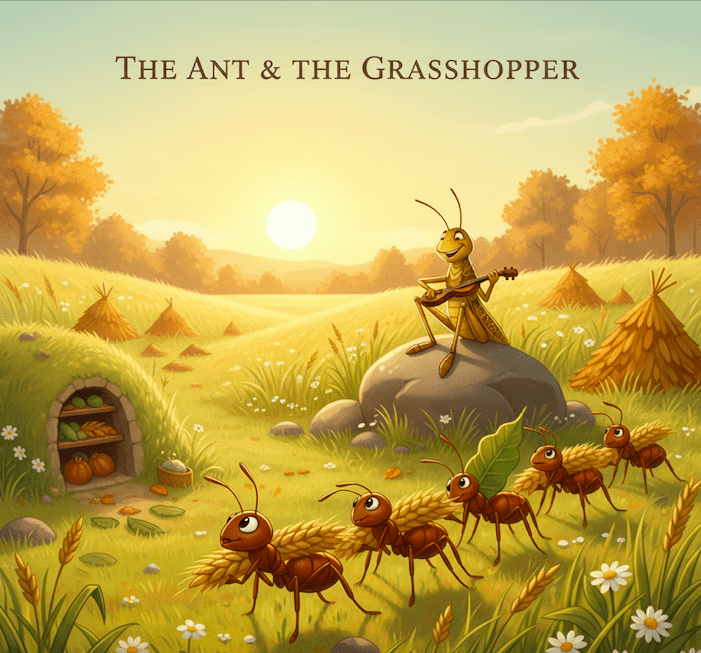
All summer, the hardworking ant stored grains for winter, while the playful grasshopper sang and danced.
The grasshopper invited the ant to join him, but the ant refused, focusing on its work.
When winter arrived, the grasshopper was cold and starving. He went to the ant's house for help.
The ant shared its food but said, "If you had worked in summer, you wouldn't be in trouble now."
Moral: Work hard today to be secure tomorrow.
हिंदी (Hindi): चींटी और टिड्डा
पूरी गर्मी, मेहनती चींटी सर्दी के लिए अनाज जमा करती रही, जबकि मस्ती करने वाला टिड्डा गाता और नाचता रहा।
टिड्डे ने चींटी को आमंत्रित किया, लेकिन चींटी ने मना कर दिया। सर्दी आने पर टिड्डा ठंडा और भूखा रह गया। वह चींटी के घर मदद माँगने गया।
चींटी ने भोजन साझा किया पर कहा, "अगर तुमने गर्मी में काम किया होता, तो आज मुसीबत में नहीं होते।"
शिक्षा: आज मेहनत करो ताकि कल सुरक्षित रह सको।
Die Ameise und die Heuschrecke (Deutsch)
Den ganzen Sommer über sammelte die fleißige Ameise Körner für den Winter.
Die fröhliche Heuschrecke sang und tanzte den ganzen Tag.
Die Heuschrecke lud die Ameise zum Mitmachen ein, aber die Ameise arbeitete weiter.
Als der Winter kam, war die Heuschrecke hungrig und kalt. Sie ging zur Ameise und bat um Hilfe.
Die Ameise teilte ihr Essen und sagte:
„Wenn du im Sommer gearbeitet hättest, wärst du jetzt nicht in Schwierigkeiten.“
Moral:
Arbeite heute fleißig, damit du morgen sicher bist.
3. The Boy Who Cried Wolf
English:
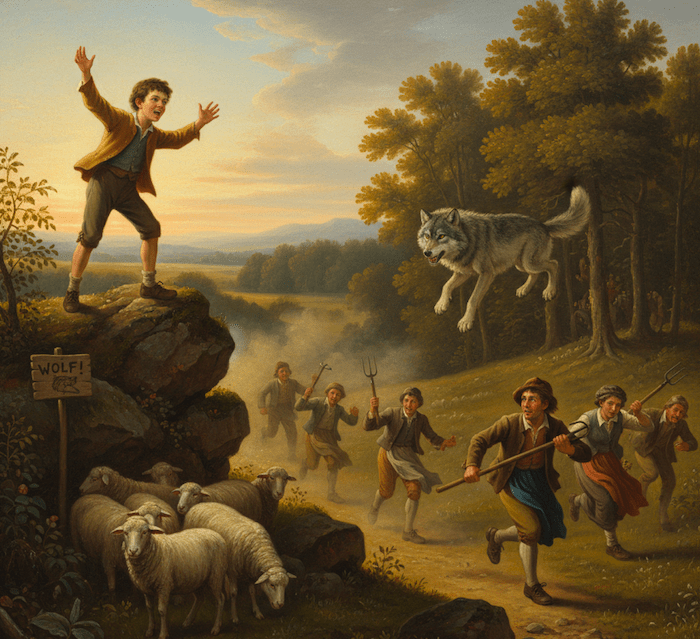
A shepherd boy was bored watching his sheep. To have fun, he shouted, "Wolf! Wolf!"
The villagers ran to help, but found no wolf. The boy laughed. He did it again, and the villagers were angry.
One day, a real wolf attacked the sheep. The boy cried for help, but no one came, thinking it was another trick.
The wolf scattered his flock.
Moral: If you tell lies, people won't believe you even when you tell the truth.
हिंदी (Hindi): झूठा गडरिया
एक गडरिया लड़का अपनी भेड़ों की देखभाल करते हुए बोर हो रहा था।
मज़े के लिए उसने चिल्लाया, "भेड़िया! भेड़िया!" गाँव वाले मदद के लिए दौड़े, लेकिन कोई भेड़िया नहीं था।
लड़का हँसा। उसने फिर से ऐसा किया, और गाँव वाले गुस्सा हो गए। एक दिन, एक असली भेड़िया ने भेड़ों पर हमला किया।
लड़के ने मदद के लिए चिल्लाया, लेकिन कोई नहीं आया। भेड़िया भेड़ों को लेकर भाग गया।
शिक्षा: यदि तुम झूठ बोलोगे, तो सच बोलने पर भी लोग तुम पर विश्वास नहीं करेंगे।
Der Hirtenjunge und der Wolf (Deutsch)
Ein Hirtenjunge langweilte sich, während er auf seine Schafe aufpasste.
Aus Spaß rief er:
„Wolf! Wolf!“
Die Dorfbewohner liefen herbei, aber es gab keinen Wolf.
Der Junge lachte. Er wiederholte den Streich, und die Leute wurden wütend.
Eines Tages kam wirklich ein Wolf und griff die Schafe an.
Der Junge schrie um Hilfe, doch niemand kam, denn alle dachten, es sei wieder eine Lüge.
Der Wolf zerstreute die Herde.
Moral:
Wer lügt, dem glaubt man nicht, selbst wenn er die Wahrheit sagt.
4. The Thirsty Crow

English:
On a hot day, a thirsty crow found a pitcher with a little water at the bottom. His beak couldn't reach it.
He tried to push the pitcher, but it was heavy. Suddenly, he got an idea.
He started picking up pebbles nearby and dropping them into the pitcher one by one.
The water level rose, and he finally drank the water.
Moral: Where there is a will, there is a way. Think cleverly to solve problems.
हिंदी (Hindi): प्यासा कौआ
एक गर्म दिन, एक प्यासे कौए ने एक घड़ा देखा जिसमें तल में थोड़ा पानी था।
उसकी चोंच पानी तक नहीं पहुँच पा रही थी। उसने घड़े को धकेलने की कोशिश की, पर वह भारी था।
तभी उसे एक विचार आया।
उसने आस-पास के कंकड़ उठाकर घड़े में एक-एक करके डालने शुरू किए।
पानी का स्तर ऊपर आ गया और उसने पानी पी लिया।
शिक्षा: जहाँ चाह होती है, वहाँ राह निकल आती है। समस्याओं को हल करने के लिए चतुराई से सोचो।
Der durstige Rabe (Deutsch)
An einem heißen Tag war ein Rabe sehr durstig.
Er fand einen Krug, in dem sich nur wenig Wasser am Boden befand.
Sein Schnabel konnte das Wasser nicht erreichen.
Der Rabe versuchte, den Krug umzustoßen, aber er war zu schwer.
Plötzlich hatte er eine Idee.
Er sammelte kleine Steine und ließ sie einen nach dem anderen in den Krug fallen.
Der Wasserspiegel stieg, und der Rabe konnte endlich trinken.
Moral:
Wo ein Wille ist, ist auch ein Weg.
Denke klug, um Probleme zu lösen.
5. The Golden Egg

English:
A poor farmer had a magical goose that laid one golden egg every day.
Soon he became rich. But he grew greedy and impatient. He thought, "The goose must have many golden eggs inside."
So, he killed the goose. To his shock, he found nothing but a normal goose inside.
He lost the goose and his daily golden eggs forever.
Moral: Greed destroys what you have. Don't be greedy.
हिंदी (Hindi): सोने का अंडा
एक गरीब किसान के पास एक जादुई बत्तख थी जो हर दिन एक सोने का अंडा देती थी।
जल्द ही वह अमीर हो गया। लेकिन वह लालची और अधीर हो गया। उसने सोचा,
"इस बत्तख के पेट में तो बहुत सारे सोने के अंडे होंगे।" इसलिए,
उसने बत्तख को मार डाला। उसके आश्चर्य की सीमा न रही जब अंदर एक साधारण बत्तख मिली।
उसने बत्तख और अपने दैनिक सोने के अंडे दोनों खो दिए।
शिक्षा: लालच बुरी बला है। लालच मत करो।
Die goldene Gans (Deutsch)
Ein armer Bauer hatte eine magische Gans, die jeden Tag ein goldenes Ei legte.
Bald wurde der Bauer reich.
Doch er wurde gierig und ungeduldig.
Er dachte: „In der Gans müssen viele goldene Eier sein.“
Also tötete er die Gans.
Zu seinem Schock fand er nichts als eine normale Gans.
Er verlor die Gans und alle goldenen Eier für immer.
Moral:
Gier zerstört, was man besitzt.
Sei nicht gierig.
6. The Tortoise and the Hare
English:
A hare made fun of a slow-moving tortoise.
The tortoise, tired of the teasing, challenged the hare to a race.
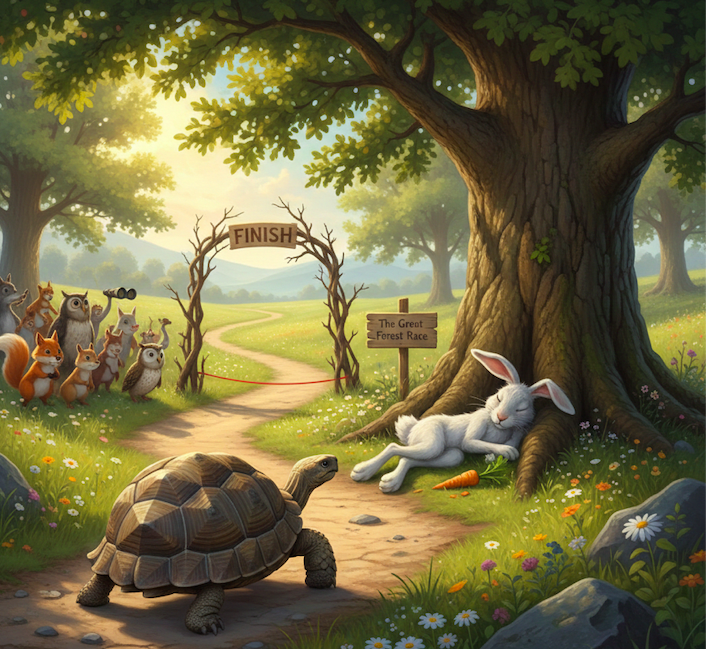
Confident of winning, the hare ran fast and then decided to take a nap.
Meanwhile, the tortoise kept walking slowly but steadily.
The hare woke up too late and saw the tortoise crossing the finish line.
Moral: Slow and steady wins the race. Overconfidence can lead to failure.
हिंदी (Hindi): कछुआ और खरगोश
एक खरगोश ने धीरे चलने वाले कछुए का मज़ाक उड़ाया।
तंग आकर, कछुए ने खरगोश को दौड़ की चुनौती दे दी।
जीत के भरोसे में, खरगोश तेज़ दौड़ा और फिर सोने लगा।
इस बीच, कछुआ धीरे लेकिन लगातार चलता रहा।
खरगोश देर से जागा और देखा कि कछुआ फिनिश लाइन पार कर रहा है।
शिक्षा: धीरे और स्थिर चलने वाला ही जीतता है। अति आत्मविश्वास असफलता का कारण बन सकता है।
Die Schildkröte und der Hase (Deutsch)
Ein Hase machte sich über eine langsame Schildkröte lustig.
Die Schildkröte hatte genug und forderte den Hasen zu einem Wettrennen heraus.
Der Hase war sehr selbstsicher, rannte schnell los und legte sich dann schlafen.
Die Schildkröte ging langsam, aber ständig weiter.
Als der Hase aufwachte, war es zu spät.
Die Schildkröte hatte bereits die Ziellinie überquert.
Moral:
Langsam und stetig gewinnt das Rennen.
Überheblichkeit führt zum Scheitern.
7. The Fox and the Grapes

English:
A hungry fox saw a bunch of juicy grapes hanging from a high vine.
He jumped to get them but couldn't reach. He jumped again and again,
but in vain. Finally, tired and disappointed, he walked away saying,
"I'm sure those grapes are sour anyway. I didn't want them."
Moral: It is easy to despise what you cannot get.
हिंदी (Hindi): लोमड़ी और अंगूर
एक भूखी लोमड़ी ने ऊँची बेल पर लटके रसीले अंगूरों का एक गुच्छा देखा।
उसने उन्हें पाने के लिए छलांग लगाई, पर वह नहीं पहुँच पाई।
उसने बार-बार कोशिश की, पर असफल रही।
आखिरकार, थककर और निराश होकर, वह चलते हुए बोली,
"मुझे यकीन है कि ये अंगूर खट्टे हैं ही। मुझे इनकी चाहत भी नहीं थी।"
शिक्षा: जो चीज़ नहीं मिलती, उसकी बुराई करना आसान है।
Der Fuchs und die Trauben (Deutsch)
Ein hungriger Fuchs sah saftige Trauben, die hoch an einem Weinstock hingen.
Er sprang, um sie zu erreichen, aber es gelang ihm nicht.
Er sprang immer wieder, doch vergeblich.
Schließlich ging er müde davon und sagte:
„Diese Trauben sind bestimmt sowieso sauer. Ich wollte sie gar nicht.“
Moral:
Es ist leicht, das zu verachten, was man nicht bekommen kann.
8. The Monkey and the Crocodile

English:
A monkey and a crocodile became friends.
The crocodile's wife wanted to eat the monkey's heart.
The crocodile sadly invited the monkey for dinner at his home across the river.
Midway, he revealed the truth. The quick-thinking monkey said, "Oh no! I left my heart on the tree. Let's go back."
The foolish crocodile took him back, and the monkey jumped to safety.
Moral: Presence of mind saves you from danger.
हिंदी (Hindi): बंदर और मगरमच्छ
एक बंदर और एक मगरमच्छ दोस्त बन गए। मगरमच्छ की पत्नी बंदर का दिल खाना चाहती थी।
मगरमच्छ ने उदास होकर बंदर को नदी पार अपने घर खाने पर बुलाया। नदी के बीच में, उसने सच बता दिया।
तेज़ दिमाग वाले बंदर ने कहा, "अरे नहीं! मैं अपना दिल पेड़ पर भूल आया हूँ।
चलो वापस चलते हैं।" मूर्ख मगरमच्छ उसे वापस ले गया और बंदर सुरक्षित पेड़ पर कूद गया।
शिक्षा: सूझबूझ आपको खतरे से बचा सकती है।
Der Affe und das Krokodil (Deutsch)
Ein Affe und ein Krokodil wurden gute Freunde.
Die Frau des Krokodils wollte jedoch das Herz des Affen essen.
Traurig lud das Krokodil den Affen zum Abendessen in sein Haus auf der anderen Seite des Flusses ein.
Mitten im Fluss sagte es dem Affen die Wahrheit.
Der schlaue Affe sagte schnell:
„Oh nein! Ich habe mein Herz auf dem Baum vergessen. Lass uns zurückgehen.“
Das dumme Krokodil brachte ihn zurück ans Ufer.
Der Affe sprang auf den Baum und war in Sicherheit.
Moral:
Geistesgegenwart rettet vor Gefahr.
9. Two Friends and the Bear

English:
Two friends were walking through a forest. Suddenly, a bear appeared.
One friend quickly climbed a tree, leaving the other behind.
The friend on the ground knew he couldn't outrun the bear,
so he lay still and held his breath, pretending to be dead. The bear sniffed him and left.
The friend from the tree came down and asked, "What did the bear whisper?" He replied,
"The bear told me never to trust a friend who leaves you in danger."
Moral: A friend in need is a friend indeed.
हिंदी (Hindi): दो दोस्त और भालू
दो दोस्त एक जंगल से गुज़र रहे थे। अचानक एक भालू आ गया।
एक दोस्त तेज़ी से पेड़ पर चढ़ गया, दूसरे को अकेला छोड़कर। ज़मीन वाले दोस्त ने सोचा कि वह भालू से तेज़ नहीं दौड़ सकता,
इसलिए वह बिल्कुल स्थिर लेट गया और साँस रोक ली, मरे होने का नाटक किया।
भालू ने उसे सूँघा और चला गया। पेड़ वाला दोस्त नीचे आया और पूछा, "भालू ने तुम्हारे कान में क्या कहा?"
उसने जवाब दिया, "भालू ने मुझसे कहा कि उस दोस्त पर कभी
भरोसा मत करना जो तुम्हें मुसीबत में अकेला छोड़ दे।"
शिक्षा: जो दोस्त मुसीबत में साथ दे, वही सच्चा दोस्त होता है।
Zwei Freunde und der Bär (Deutsch)
Zwei Freunde gingen durch einen Wald.
Plötzlich erschien ein Bär.
Einer der Freunde kletterte schnell auf einen Baum und ließ den anderen allein.
Der andere Freund legte sich reglos auf den Boden und hielt den Atem an, als wäre er tot.
Der Bär schnupperte an ihm und ging weg.
Als der Freund vom Baum herunterkam, fragte er:
Was hat dir der Bär ins Ohr geflüstert?“
Der Freund antwortete:
„Der Bär sagte mir, ich solle keinem Freund vertrauen, der mich in Gefahr allein lässt.“
Moral:
Ein Freund in der Not ist ein wahrer Freund.
10. The Cap Seller and the Monkeys
English:
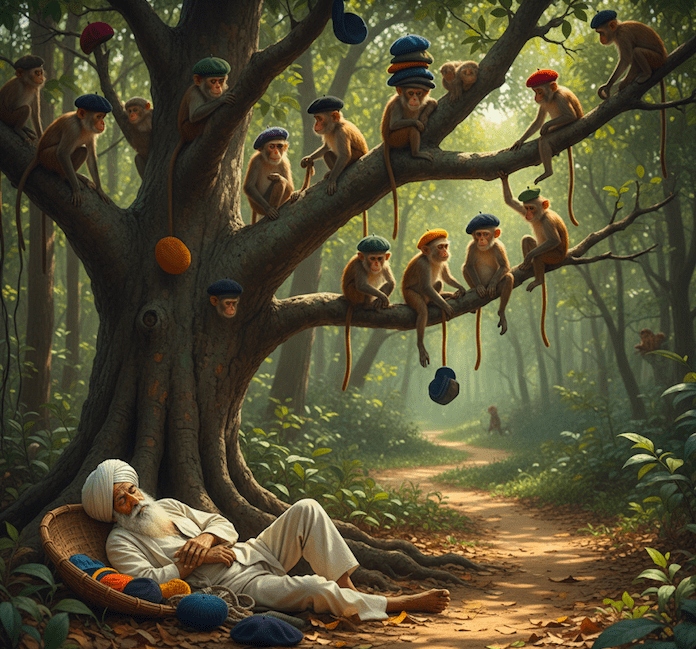
A cap seller was taking a nap under a tree, with his basket of caps beside him.
When he woke up, the basket was empty! He looked up and saw monkeys on the tree, each wearing a cap.
He tried everything, but the monkeys just imitated him. In frustration, he took off his own cap and threw it down.
The monkeys did the same! He collected all his caps and left.
Moral: Intelligence wins over mimicry.
हिंदी (Hindi): टोपीवाला और बंदर
एक टोपी बेचने वाला अपनी टोपियों की टोकरी के साथ एक पेड़ के नीचे झपकी ले रहा था।
जब वह जागा, तो टोकरी खाली थी! उसने ऊपर देखा तो पेड़ पर बंदर थे, और हर एक ने एक टोपी पहन रखी थी।
उसने हर कोशिश की, पर बंदर उसकी नकल करते रहे। निराश होकर, उसने अपनी खुद की टोपी उतारी और ज़मीन पर फेंक दी।
बंदरों ने भी ऐसा ही किया! उसने सारी टोपियाँ इकट्ठी कीं और चला गया।
शिक्षा: नकल से बुद्धि बड़ी होती है।
Der Mützenverkäufer und die Affen (Deutsch)
Ein Mützenverkäufer machte unter einem Baum ein Nickerchen.
Sein Korb mit Mützen stand neben ihm.
Als er aufwachte, war der Korb leer.
Er sah nach oben und entdeckte Affen, die alle seine Mützen trugen.
Was auch immer er tat, die Affen ahmten ihn nach.
Wütend nahm er seine eigene Mütze ab und warf sie auf den Boden.
Die Affen machten es ihm nach.
So sammelte er alle Mützen ein und ging glücklich weiter.
Moral:
Intelligenz besiegt Nachahmung.
11. The Dog and His Reflection

English:
A greedy dog stole a piece of meat from a butcher's shop.
While crossing a bridge over a stream, he saw his own reflection in the water.
Thinking it was another dog with a bigger piece of meat, he growled and snapped at it.
As he opened his mouth, his own piece of meat fell into the water and was lost.
He had to go home hungry.
Moral: Greed makes you lose what you already have.
हिंदी (Hindi): कुत्ता और उसकी परछाईं
एक लालची कुत्ते ने कसाई की दुकान से मांस का एक टुकड़ा चुरा लिया।
एक नदी के ऊपर बने पुल से गुज़रते समय, उसने पानी में अपनी परछाई देखी।
यह सोचकर कि यह एक और कुत्ता है जिसके पास मांस का बड़ा टुकड़ा है,
उसने उस पर गुर्राकर हमला करने की कोशिश की।
जैसे ही उसने मुँह खोला,
उसका अपना मांस का टुकड़ा पानी में गिर गया और खो गया।
उसे भूखा ही घर लौटना पड़ा।
शिक्षा: लालच तुम्हारे पास जो है उसे भी खो देता है।
Der Hund und sein Spiegelbild (Deutsch)
Ein gieriger Hund stahl ein Stück Fleisch aus einer Metzgerei.
Als er über eine Brücke ging, sah er im Wasser sein Spiegelbild.
Er dachte, es sei ein anderer Hund mit einem größeren Stück Fleisch.
Er knurrte und schnappte danach.
Dabei ließ er sein eigenes Fleisch fallen, und es versank im Wasser.
Der Hund ging hungrig nach Hause.
Moral:
Gier lässt dich verlieren, was du schon hast.
12. The Wind and the Sun

English:
The Wind and the Sun argued about who was stronger.
They saw a traveler wearing a coat and decided that whoever
could make him take off his coat would be the winner.
The Wind blew fiercely, but the traveler only wrapped his coat tighter.
Then the Sun shone gently and warmly. Soon, the traveler felt hot
and happily removed his coat.
Moral: Kindness and gentleness are more powerful than force and anger.
हिंदी (Hindi): हवा और सूरज
हवा और सूरज में तर्क हुआ कि कौन अधिक शक्तिशाली है।
उन्होंने एक यात्री को कोट पहने देखा और तय किया कि जो उसका कोट उतरवा देगा, वह जीतेगा।
हवा ने ज़ोर से बहना शुरू किया, लेकिन यात्री ने कोट और कसकर लपेट लिया।
फिर सूरज ने धीरे-धीरे और गर्मी से चमकना शुरू किया। जल्द ही,
यात्री को गर्मी लगने लगी और उसने खुशी से कोट उतार दिया।
शिक्षा: दयालुता और कोमलता, बल और गुस्से से अधिक शक्तिशाली होती हैं।
Der Wind und die Sonne (Deutsch)
Der Wind und die Sonne stritten darüber, wer stärker sei.
Sie sahen einen Wanderer mit einem Mantel.
Der Wind blies sehr stark, doch der Wanderer zog den Mantel nur fester an.
Dann schien die Sonne warm und freundlich.
Bald wurde dem Wanderer heiß, und er zog den Mantel aus.
Moral:
Freundlichkeit und Sanftheit sind stärker als Gewalt und Wut.
13. The Goose with the Golden Eggs (Different Version)
English:
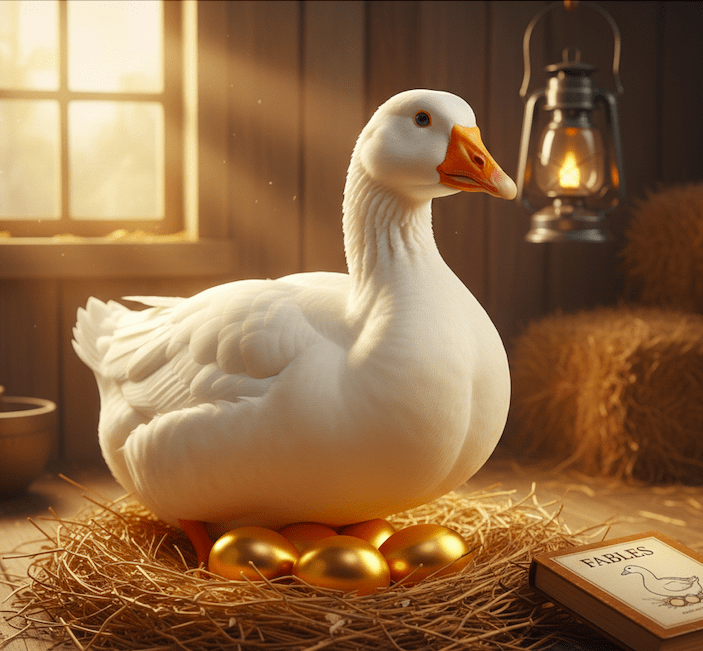
A man and his wife owned a wonderful goose that laid a golden egg every day.
They became rich, but grew more greedy each day.
"If the goose can lay golden eggs, its insides must be made of gold!" they thought.
So, they killed the goose and cut it open, only to find it like any other goose.
They cried, realizing their foolish greed had cost them their fortune.
Moral: Too much greed leads to great loss.
हिंदी (Hindi): सोने के अंडे वाली बत्तख (अलग संस्करण)
एक आदमी और उसकी पत्नी के पास एक अद्भुत बत्तख थी
जो हर रोज़ एक सोने का अंडा देती थी। वे अमीर हो गए,
लेकिन हर दिन और लालची होते गए। "अगर बत्तख सोने के अंडे दे सकती है,
तो इसके अंदर भी सोना ही होगा!" उन्होंने सोचा। इसलिए, उन्होंने बत्तख को मार डाला और चीर दिया,
लेकिन अंदर से वह बिल्कुल एक साधारण बत्तख निकली। वे रोए, यह समझते हुए
कि उनकी मूर्खतापूर्ण लालच ने उनकी किस्मत ही छीन ली।
शिक्षा: अत्यधिक लालच बड़े नुकसान की ओर ले जाता है।
Die Gans mit den goldenen Eiern (Deutsch)
Ein Mann und seine Frau hatten eine Gans, die jeden Tag ein goldenes Ei legte.
Sie wurden reich, aber auch immer gieriger.
Sie dachten:
„Wenn sie goldene Eier legt, muss sie innen aus Gold bestehen!“
Also töteten sie die Gans und schnitten sie auf.
Doch sie war wie jede andere Gans.
Weinend erkannten sie, dass ihre Gier alles zerstört hatte.
Moral:
Zu viel Gier führt zu großem Verlust.
14. The Fox and the Stork
English:
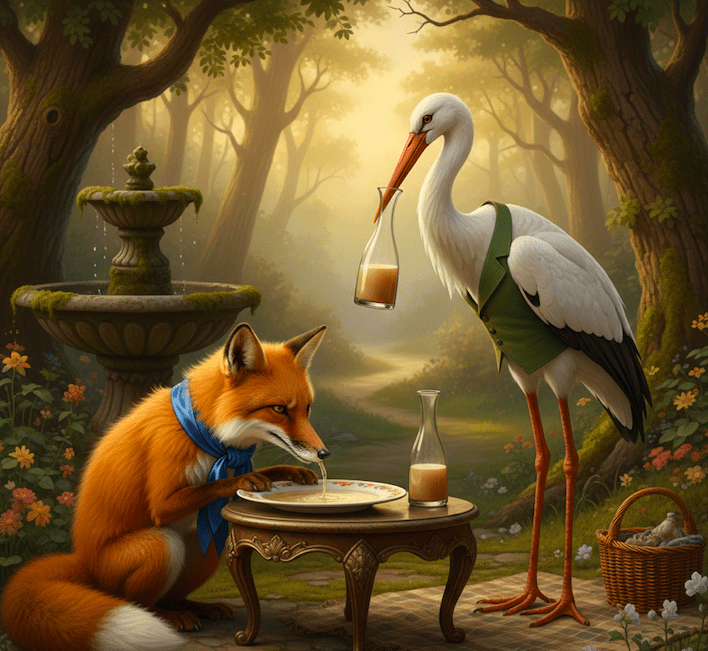
A fox invited a stork for dinner and served soup in a flat plate.
The fox lapped it up easily, but the stork with her long beak couldn't eat a drop.
The next day, the stork invited the fox for dinner and served food in a tall, narrow jar.
The stork ate easily, but the fox couldn't reach the food.
The fox understood his mistake.
Moral: Treat others the way you want to be treated.
हिंदी (Hindi): लोमड़ी और सारस
एक लोमड़ी ने सारस को रात के खाने पर बुलाया और सूप एक सपाट प्लेट में परोसा।
लोमड़ी आसानी से चाट गई, लेकिन लंबी चोंच वाला सारस एक बूंद भी नहीं खा पाया।
अगले दिन, सारस ने लोमड़ी को खाने पर बुलाया और खाना एक लंबे, संकरे जार में परोसा।
सारस ने आसानी से खा लिया, लेकिन लोमड़ी खाने तक नहीं पहुँच पाई।
लोमड़ी को अपनी गलती समझ आ गई।
शिक्षा: दूसरों के साथ वैसा ही व्यवहार करो जैसा तुम अपने लिए चाहते हो।
Der Fuchs und der Storch
Ein Fuchs lud einen Storch zum Abendessen ein. Er servierte Suppe auf einem flachen Teller.
Der Fuchs konnte die Suppe leicht auflecken, aber der Storch konnte mit seinem langen Schnabel keinen Tropfen trinken.
Am nächsten Tag lud der Storch den Fuchs ein. Er servierte das Essen in einem hohen, schmalen Krug.
Der Storch aß problemlos, aber der Fuchs kam nicht an das Essen heran.
Der Fuchs verstand seinen Fehler.
Moral:
Behandle andere so, wie du selbst behandelt werden möchtest.
15. The Crow and the Peacock

English:
A crow lived unhappily in the jungle, jealous of the colorful peacock.
He collected fallen peacock feathers and stuck them onto his own body.
He then proudly joined the peacocks. But the peacocks saw through his disguise, pecked at him,
and pulled out the fake feathers. The other crows also rejected him for being a copycat.
The crow was left alone and sad.
Moral: Be yourself. Imitating others brings no true happiness.
हिंदी (Hindi): कौआ और मोर
एक कौआ जंगल में दुखी रहता था, रंग-बिरंगे मोर से जलता था।
उसने ज़मीन पर गिरे मोर के पंख इकट्ठे किए और अपने शरीर पर चिपका लिए।
फिर गर्व से वह मोरों के बीच जा बैठा। लेकिन मोरों ने उसका भेष देख लिया,
उसे चोंच मारी और नकली पंख नोच डाले। दूसरे कौओं ने भी उसे नकलची कहकर ठुकरा दिया।
कौआ अकेला और दुखी रह गया।
शिक्षा: अपने आप को स्वीकार करो। दूसरों की नकल करने से सच्ची खुशी नहीं मिलती।
Die Krähe und der Pfau
Eine Krähe lebte unglücklich im Wald und war neidisch auf den bunten Pfau.
Sie sammelte gefallene Pfauenfedern und steckte sie an ihren Körper.
Stolz ging sie zu den Pfauen. Doch die Pfauen erkannten den Betrug, rissen die Federn heraus und jagten sie weg.
Auch die anderen Krähen wollten nichts mehr mit ihr zu tun haben.
Die Krähe blieb allein und traurig zurück.
Moral:
Sei du selbst. Nachahmen bringt kein echtes Glück.
16. The Fox Without a Tail

English:
A fox got his tail caught in a trap and lost it.
Feeling embarrassed, he thought of a plan. He called all the foxes and said,
"Tails are useless! They are heavy and get dirty. Look at me, I'm free!"
An old, wise fox smiled and said, "
You would not be saying this if you still had your own tail."
The others understood his selfish motive.
Moral: Do not trust someone who gives advice from a selfish point of view.
हिंदी (Hindi): बिना पूँछ की लोमड़ी
एक लोमड़ी की पूँछ एक जाल में फँस गई और कट गई।
शर्मिंदा महसूस करते हुए, उसने एक योजना बनाई। उसने सभी लोमड़ियों को बुलाकर कहा,
"पूँछ बेकार है! यह भारी होती है और गंदी हो जाती है। मुझे देखो, मैं आज़ाद हूँ!" एक बूढ़ी,
समझदार लोमड़ी मुस्कुराई और बोली, "तुम यह बात नहीं कह रहे होते अगर तुम्हारी अपनी पूँछ होती।"
बाकियों को उसका स्वार्थी मकसद समझ आ गया।
शिक्षा: उस व्यक्ति पर भरोसा मत करो जो स्वार्थ की दृष्टि से सलाह देता है।
Der Fuchs ohne Schwanz
Ein Fuchs verlor seinen Schwanz in einer Falle. Er schämte sich sehr und machte einen Plan.
Er rief alle Füchse zusammen und sagte:
„Schwänze sind nutzlos! Sie sind schwer und werden schmutzig. Seht mich an – ich bin frei!“
Ein alter, kluger Fuchs lächelte und sagte:
„Das würdest du nicht sagen, wenn du deinen Schwanz noch hättest.“
Die anderen Füchse verstanden seinen egoistischen Plan.
Moral:
Vertraue niemandem, der aus Eigennutz Ratschläge gibt.
17. The Bundle of Sticks

English:
An old man had three sons who always quarreled.
To teach them a lesson, he gave them a bundle of sticks and asked them to break it.
Each son tried but failed. Then the old man untied the bundle and gave each son a single stick.
They broke the sticks easily. He said, "Together, you are strong like the bundle. Divided,
you are weak and can be broken easily."
Moral: Unity is strength.
हिंदी (Hindi): लकड़ियों का गट्ठर
एक बूढ़े आदमी के तीन बेटे थे जो हमेशा झगड़ते रहते थे।
उन्हें सबक सिखाने के लिए, उसने उन्हें लकड़ियों का एक गट्ठर दिया और तोड़ने को कहा।
हर बेटे ने कोशिश की पर असफल रहा। फिर बूढ़े आदमी ने गट्ठर खोल दिया और हर बेटे को एक अलग लकड़ी दी।
उन्होंने लकड़ियाँ आसानी से तोड़ दीं। उसने कहा, "साथ मिलकर, तुम गट्ठर की तरह मजबूत हो।
अलग-अलग होकर, तुम कमज़ोर हो और आसानी से टूट सकते हो।"
शिक्षा: एकता में ही बल है।
Das Bündel Stöcke
Ein alter Mann hatte drei Söhne, die ständig stritten.
Er gab ihnen ein Bündel Stöcke und bat sie, es zu brechen. Keiner schaffte es.
Dann löste er das Bündel und gab jedem Sohn einen einzelnen Stock.
Diese konnten sie leicht brechen.
Der Vater sagte:
„Zusammen seid ihr stark. Getrennt seid ihr schwach.“
Moral:
Einigkeit macht stark.
18. The Hare and the Tortoise (New Race)
English:
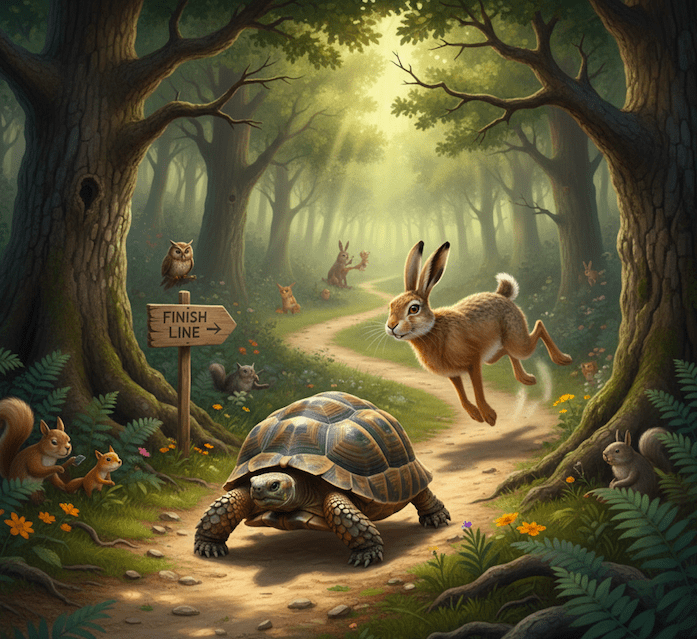
After losing, the hare challenged the tortoise to another race.
This time, the hare ran without stopping and won easily.
The tortoise then challenged the hare to a race across a river.
The hare agreed. At the river, the hare stopped, unable to swim.
The tortoise swam slowly but steadily and won.
They realized they both had different strengths.
Moral: Everyone has their own unique strengths.
Play to your strengths.
हिंदी (Hindi): खरगोश और कछुआ (नई दौड़)
हारने के बाद, खरगोश ने कछुए को एक और दौड़ की चुनौती दी।
इस बार, खरगोश बिना रुके दौड़ा और आसानी से जीत गया।
तब कछुए ने खरगोश को एक नदी पार करने की दौड़ की चुनौती दी। खरगोश मान गया। नदी के किनारे,
खरगोश रुक गया, तैर नहीं सकता था। कछुआ धीरे-धीरे लेकिन लगातार तैरा और जीत गया।
उन्हें समझ आया कि दोनों की अपनी-अपनी अलग ताकतें हैं।
शिक्षा: हर किसी की अपनी विशेष ताकत होती है। अपनी ताकत पर खेलो।
Der Hase und die Schildkröte (Teil 2)
Nach seiner Niederlage forderte der Hase die Schildkröte zu einem neuen Rennen heraus.
Diesmal rannte der Hase ohne Pause und gewann leicht.
Dann forderte die Schildkröte den Hasen zu einem Rennen über einen Fluss heraus.
Der Hase konnte nicht schwimmen und blieb stehen.
Die Schildkröte schwamm langsam, aber stetig, und gewann.
Beide verstanden, dass sie unterschiedliche Stärken haben.
Moral:
Jeder hat seine eigenen Stärken. Nutze deine Stärken.
19. The Donkey and the Load of Salt
English:
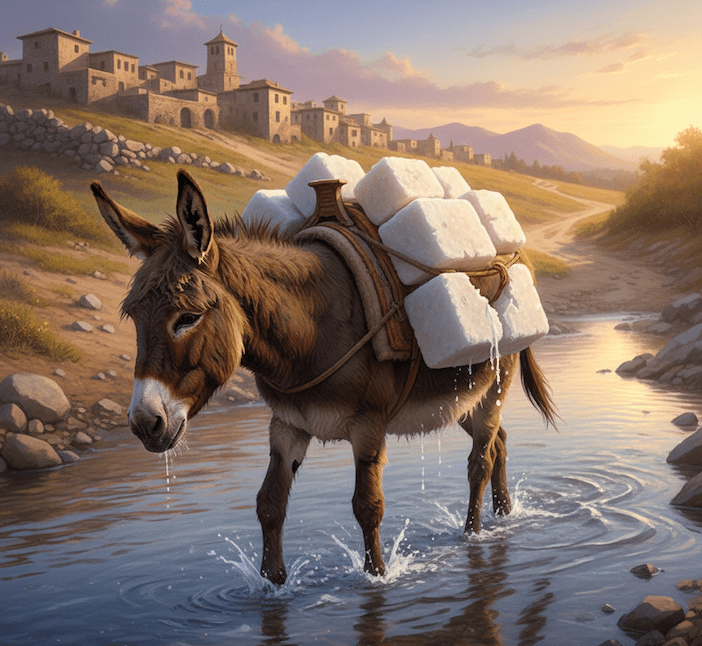
A donkey carried bags of salt across a river. He slipped,
and some salt dissolved in water, making his load lighter. The next day,
he pretended to slip on purpose. His owner understood the trick.
The following day, he loaded the donkey with sponges. When the donkey slipped again,
the sponges soaked up water and became extremely heavy.
Moral: A trick might work once, but honesty is the best policy in the long run.
हिंदी (Hindi): गधा और नमक का बोझ
एक गधा नमक के बोरे नदी पार ले जा रहा था।
वह फिसला, और कुछ नमक पानी में घुल गया, जिससे उसका बोझ हल्का हो गया।
अगले दिन, उसने जानबूझकर फिसलने का नाटक किया। उसके मालिक को यह चाल समझ आ गई।
अगले दिन, उसने गधे पर स्पंज लाद दिए। जब गधा फिर फिसला,
तो स्पंज पानी सोखकर बहुत भारी हो गए।
शिक्षा: चाल एक बार चल सकती है, लेकिन लंबे समय में ईमानदारी सबसे अच्छी नीति है।
Der Esel und die Salzsäcke
Ein Esel trug Säcke mit Salz über einen Fluss.
Er rutschte aus, und das Salz löste sich im Wasser auf. Die Last wurde leichter.
Am nächsten Tag rutschte der Esel absichtlich aus.
Der Besitzer verstand den Trick.
Am folgenden Tag lud er dem Esel Schwämme auf.
Als der Esel wieder ausrutschte, saugten sich die Schwämme voll Wasser und wurden sehr schwer.
Moral:
Ein Trick funktioniert vielleicht einmal, aber Ehrlichkeit ist langfristig der beste Weg.
20. The Wise Pigeon
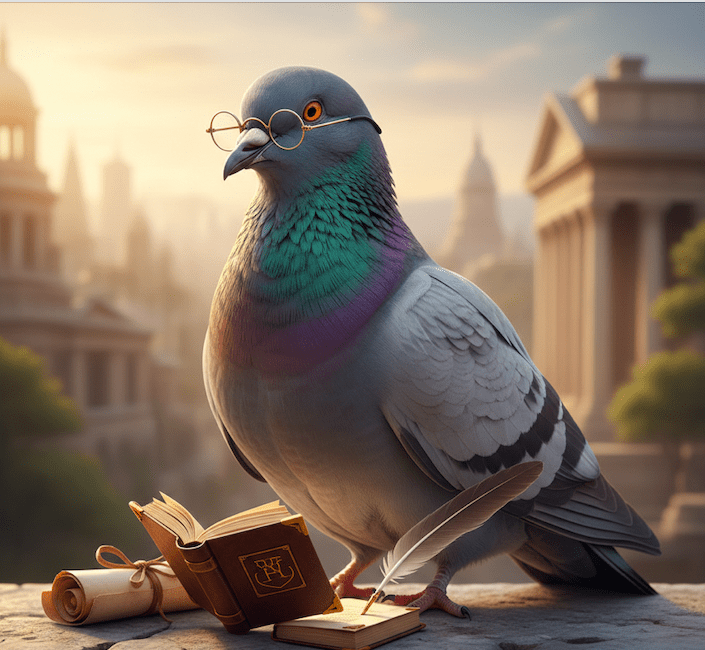
English:
A flock of pigeons got caught in a hunter's net.
They all started flapping wildly, trying to escape alone,
but only got more tangled. Their leader, a wise pigeon,
said, "Stop! If we all fly up together at the same time, we can lift the net."
They did as he said. United, they flew high, carrying the net with them,
and later chewed through it to freedom.
Moral: Working together as a team can solve even the biggest problems.
हिंदी (Hindi): बुद्धिमान कबूतर
कबूतरों का एक झुंड शिकारी के जाल में फँस गया।
वे सभी अलग-अलग छूटने की कोशिश में ज़ोर-ज़ोर से फड़फड़ाने लगे, लेकिन और उलझ गए।
उनका नेता, एक बुद्धिमान कबूतर, बोला, "रुको!
अगर हम सब एक साथ एक ही समय में ऊपर उड़ें, तो हम इस जाल को उठा सकते हैं।"
सबने वैसा ही किया। एकजुट होकर, वे जाल को साथ लेकर ऊँचा उड़े,
और बाद में उसे कुतरकर आज़ाद हो गए।
शिक्षा: एक टीम के रूप में साथ मिलकर काम करने से सबसे बड़ी समस्या भी हल हो सकती है।
Die weisen Tauben
Eine Gruppe Tauben geriet in ein Netz eines Jägers.
Jede versuchte allein zu entkommen, doch sie verhedderten sich nur noch mehr.
Ihr Anführer sagte:
„Hört auf! Wenn wir alle zusammen gleichzeitig fliegen, können wir das Netz hochheben.“
Sie taten es und flogen gemeinsam davon. Später nagten sie das Netz durch und wurden frei.
Moral:
Gemeinsam können selbst große Probleme gelöst werden.


Comments (0)
No comments yet. Be the first to comment!